

28
Aug
DIY Water Damage in Tampa: What Homeowners Can Safely Handle vs When to Call a Pro
You’ve just discovered a puddle near your A/C unit at 11 PM on a Tuesday, or maybe your washing machine supply line gave out while you were at work—and now you’re Googling “DIY water damage repair Tampa” wondering if you can handle this yourself or if you need to call in the pros at midnight. The good news: not every water event requires an emergency call, but knowing the difference between a safe DIY project and a disaster-in-the-making can save your Tampa Bay home from mold, structural damage, and a much bigger repair bill. Let’s break down exactly what Hillsborough and Pinellas County homeowners can safely tackle themselves versus when it’s time to call 911 Restoration of Tampa Bay at (813) 261-1525. For local help, see water damage restoration Tampa.
Understanding Water Damage Categories: The Foundation of Your Decision
Before you grab that wet/dry vacuum, you need to understand that not all water is created equal. Water damage professionals categorize water intrusion into three distinct types, and this classification determines whether you’re looking at a DIY project or a situation that requires professional intervention.
Category 1: Clean Water (Sometimes DIY-Friendly)
Category 1 water comes from sanitary sources—think supply lines, toilet tanks (not bowls), appliance lines, melting ice, and rainwater that hasn’t contacted contaminants. In Tampa Bay’s humid climate, even clean water becomes problematic after 24-48 hours as our year-round warmth accelerates bacterial growth, but if you catch it immediately and the affected area is small, you may be able to handle it yourself.
Category 2: Gray Water (Call the Professionals)
Gray water contains significant contamination that could cause discomfort or illness—dishwasher or washing machine discharge, toilet overflow with urine (no feces), sump pump failures, or aquarium spills. This water requires protective equipment and specific sanitization protocols that most homeowners don’t have on hand.
Category 3: Black Water (Always Call Immediately)
Black water is grossly unsanitary and dangerous, containing pathogenic agents, toxic materials, or sewage. This includes all flooding from rivers or storms (yes, even Hillsborough River flooding or Pinellas County storm surge), sewage backups, toilet overflows with feces, and any standing water that’s been sitting for days. Category 3 situations always require our sewage cleanup specialists and professional-grade remediation.
Tampa-Specific Water Damage Scenarios: DIY or Call a Pro?
| Scenario | Water Category | DIY Possible? | Key Considerations |
|---|---|---|---|
| A/C condensate line leak (small) | Category 1 | Yes, if caught within 24 hrs | Tampa’s A/C units run 300+ days/year; condensate is clean but our humidity makes mold growth rapid |
| Refrigerator ice maker line leak | Category 1 | Yes, if small area affected | Tile floors common in Tampa homes are forgiving; wood floors less so |
| Washing machine overflow (detergent water) | Category 2 | No | Contains chemicals and contamination requiring sanitization |
| Hurricane/tropical storm flooding | Category 3 | Never | Contains sewage, chemicals, bacteria; extremely common in low-lying Tampa Bay areas |
| Roof leak into attic/ceiling | Depends | No | Hidden moisture in insulation breeds mold fast; structural assessment needed |
| Toilet supply line (clean water) | Category 1 | Yes, if caught immediately | Must be confident no bowl water mixed in |
| Sewage backup from street | Category 3 | Never | Common in older Tampa neighborhoods like Seminole Heights during heavy rain |
When DIY Water Damage Repair Makes Sense in Tampa Bay
If you’re dealing with a genuine Category 1 water situation that meets ALL of these criteria, you can likely handle the initial response yourself:
- Small affected area: Less than 10 square feet (roughly a 3’x3′ area)
- Clean water source confirmed: You know exactly where it came from and it’s sanitary
- Immediate discovery: You found it within hours, not days
- No porous materials heavily saturated: Tile or sealed concrete vs. carpet, drywall, or wood
- No electrical hazards: Water hasn’t reached outlets, appliances, or your electrical panel
- You have proper equipment: Wet/dry vacuum and a real dehumidifier, not just fans
The DIY Response Protocol (Category 1 Only, Small Areas)
If your situation genuinely qualifies, here’s the Tampa Bay homeowner’s action plan:
First Hour: Stop the water source immediately. Turn off the supply valve or shut off your main water line if necessary. Remove any moveable items from the affected area. Use a wet/dry vacuum (not a regular vacuum—you’ll destroy it and risk electrocution) to extract as much standing water as possible.
Hours 2-4: Pull up any wet area rugs or bath mats and hang them to dry outside if possible (Tampa’s sun is your friend here). If you have tile with wet grout, continue extracting moisture. Position a dehumidifier in the space—and we mean a real one rated for at least 50-pint capacity, not a tiny closet unit. Our ambient Tampa Bay humidity hovers around 75% year-round, so your dehumidifier is fighting an uphill battle even in air-conditioned spaces.
Days 2-3: Run that dehumidifier continuously, emptying it regularly. Use fans to increase air circulation, but don’t just blow moist air around—you need actual dehumidification. Monitor the area twice daily for any signs of mold growth (musty smell, discoloration) or spreading moisture.
If you see any of these warning signs, stop and call professional water damage restoration at (813) 261-1525:
- Water wicking up walls (visible water line climbing drywall)
- Buckling, warping, or discoloration of flooring
- Musty odors developing within 48 hours
- Water spreading to adjacent rooms
- Any uncertainty about the water source
Why Most Water Damage in Tampa Bay Homes Isn’t DIY-Appropriate
Here’s the honest truth from professionals who’ve seen thousands of Tampa Bay water damage claims: the vast majority of water intrusion events require professional intervention. That’s not a sales pitch—it’s physics and microbiology working against you in our climate.
The Tampa Bay Humidity Factor
Our year-round warmth and humidity create perfect conditions for mold growth in as little as 24-48 hours. Homes built before the 1990s in neighborhoods like Hyde Park, Beach Park, or Gulfport often have minimal vapor barriers and insulation standards that seem quaint by today’s metrics. Water enters wall cavities and insulation, where your wet/dry vac and dehumidifier can’t reach, and mold colonies establish themselves before you realize there’s a problem.
Hidden Moisture Migration
Water follows the path of least resistance, often traveling along floor joists, through wall cavities, and under baseboards to emerge in locations far from the original intrusion point. Professionals use thermal imaging cameras and moisture meters to map the full extent of water migration—equipment that costs thousands of dollars and requires training to interpret correctly.
The 24-Hour Window
Once water has been present for more than 24 hours, even Category 1 clean water begins transitioning toward Category 2 as it picks up contaminants from building materials, dust, and ambient bacteria. In Tampa’s warm environment, this transition happens faster than in northern climates. What started as a “maybe DIY” situation yesterday is a “definitely call the pros” situation today.
When to Call 911 Restoration of Tampa Bay Immediately
Some situations never fall into DIY territory, regardless of your skills, equipment, or confidence level. Contact our team at (813) 261-1525 immediately if you’re experiencing:
Roof Leaks and Ceiling Water
Water coming through your ceiling means it’s already saturated the attic insulation and potentially the ceiling drywall and framing. Tampa Bay’s afternoon thunderstorms and hurricane season create regular roofing challenges, especially for homes with aging barrel tile roofs common in our area. Even if the visible ceiling stain seems small, the hidden damage above is typically 5-10 times larger. Plus, saturated insulation loses all R-value and becomes a mold factory within days.
Any Category 2 or 3 Water
Gray water and black water contain contaminants that pose genuine health risks. Our sewage cleanup professionals use hospital-grade disinfectants, antimicrobials, and PPE (personal protective equipment) to safely remediate these situations. This isn’t about being tough or saving money—it’s about protecting your family’s health and ensuring contaminated materials are properly removed and disposed of according to Florida regulations.
Flooding From Any Source
Whether it’s the Hillsborough River overtopping after a tropical system, Pinellas County storm surge, or localized street flooding in low areas like parts of South Tampa or St. Petersburg, floodwater is always Category 3. It’s contacted sewage systems, chemicals from roads and yards, bacteria from soil, and countless other contaminants. Professional flood restoration includes complete sanitization, proper disposal of porous materials that can’t be saved, and documentation for your insurance claim.
Water Affecting Multiple Rooms or Floors
If water has spread beyond a single small area, the situation has already exceeded DIY capacity. Multi-room water damage requires industrial extraction equipment, large-capacity dehumidifiers, air movers, and careful monitoring across multiple spaces simultaneously.
Older Homes With Plaster, Wood Lath, or Pier-and-Beam Construction
Many beautiful historic Tampa Bay homes in neighborhoods like Hyde Park, Old Northeast St. Petersburg, or Safety Harbor feature construction methods that, while charming and durable when dry, become extremely vulnerable when wet. Plaster absorbs water like a sponge, wood lath swells and deteriorates rapidly, and crawlspaces under pier-and-beam homes become standing water reservoirs. These homes require specialized restoration approaches.
The Hidden Costs of DIY Water Damage Repair Gone Wrong
We’ve restored countless Tampa Bay homes where well-intentioned DIY efforts actually increased the total damage and cost. Here’s what happens:
Mold remediation becomes necessary: Incomplete drying leads to mold growth within walls, requiring professional mold removal that costs significantly more than the original water damage restoration would have. Florida’s climate makes this almost inevitable when moisture remains trapped in building cavities.
Insurance complications: Many homeowners don’t realize that improper DIY remediation can complicate insurance claims. Insurance adjusters want to see that professional mitigation occurred promptly. Our insurance coordination services help document everything properly from day one, protecting your claim and your investment.
Structural damage progression: Water that remains in subfloors, wall studs, or ceiling joists for weeks causes wood rot, warping, and in extreme cases, structural failure. What started as a $2,000 professional water extraction becomes a $20,000 structural repair and rebuild.
Secondary damage: Incomplete drying doesn’t just risk mold—it can cause paint failure, flooring delamination, corrosion of fasteners and hardware, and even attract termites (a major concern in Tampa Bay). These secondary effects often appear months later, long after you thought the problem was resolved.
What Professional Water Damage Restoration Actually Includes
When you call 911 Restoration of Tampa Bay, you’re not just getting someone with a bigger wet/dry vac. Professional water damage restoration includes:
- Emergency response: We’re available 24/7 because water damage doesn’t wait for business hours
- Complete moisture assessment: Thermal imaging and moisture meters identify all affected areas, including hidden moisture
- Proper categorization: Accurate water classification ensures appropriate protocols and safety measures
- Industrial extraction: Truck-mounted extractors remove hundreds of gallons quickly
- Controlled drying environment: Commercial dehumidifiers and air movers create optimal drying conditions while monitoring humidity and temperature
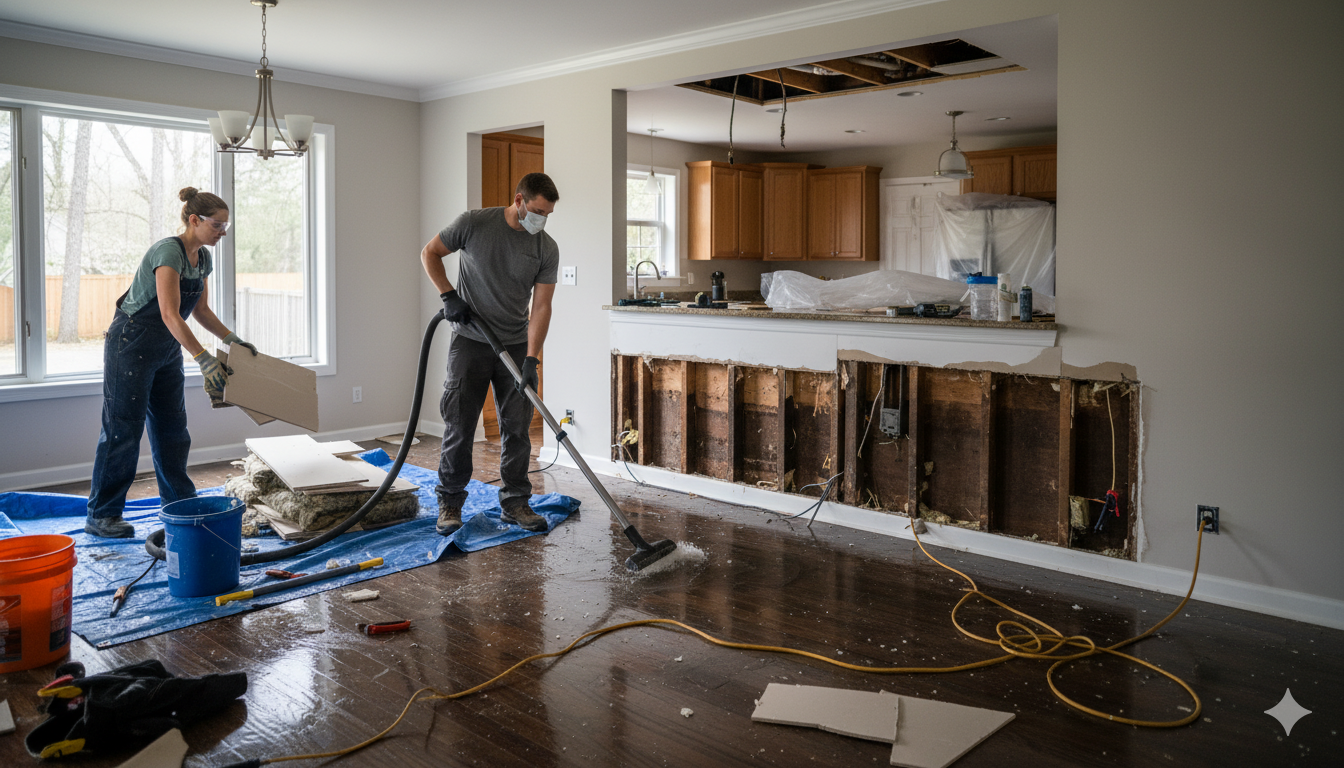
- Selective demolition: When necessary, we remove only what can’t be saved (wet insulation, saturated drywall), preserving as much as possible
- Antimicrobial treatment: Applied to affected areas to prevent microbial growth during the drying process
- Complete documentation: Photos, moisture readings, and detailed notes that support your insurance claim
- Final verification: Post-remediation testing confirms all areas are dry and safe before we consider the job complete
Your Action Plan: Making the Right Call for Your Tampa Bay Home
Water damage creates stress and urgency, but taking a moment to properly assess the situation helps you make the right decision. Ask yourself these questions:
Do I know with absolute certainty this is clean water from a sanitary source? If there’s any doubt, treat it as contaminated and call professionals.
Can I see the full extent of the damage, or might water have traveled behind walls, under flooring, or into insulation? Hidden moisture always requires professional assessment.
How long has the water been present? Beyond 24 hours, even initially clean water becomes problematic in Tampa’s climate.
Is this a small, contained area on non-porous surfaces? If water has saturated carpet, drywall, insulation, or wood, professional extraction and drying equipment is necessary.
Do I have genuine water restoration equipment—not just household fans and a small dehumidifier? Adequate equipment for even moderate water damage costs thousands of dollars.
If you answered “no” or “I’m not sure” to any of these questions, the honest answer is that your situation calls for professional help.
Get Expert Help From Tampa Bay’s Water Damage Restoration Specialists
At 911 Restoration of Tampa Bay, we respect that some Tampa and Pinellas County homeowners have the skills and equipment to handle very small, straightforward clean water incidents. But we also know that our subtropical climate, hurricane exposure, and building characteristics make most water damage situations more complex than they initially appear. We’ve built our reputation on honest assessments, rapid response, and quality work—not pressuring homeowners into services they don’t need.
If you’re facing water damage and unsure whether it’s something you can handle or a situation that requires professional intervention, we’re happy to talk through your specific scenario. Our team is available 24 hours a day, 7 days a week at (813) 261-1525 to provide guidance and, when needed, emergency response.
Water damage doesn’t improve with time—it only gets worse and more expensive. Whether you ultimately tackle a small incident yourself or bring in our professionals, the key is taking action quickly and making informed decisions that protect your home and your family’s health. Contact us today for a professional assessment and let’s make sure your Tampa Bay home is properly protected and restored.
Latest Posts
Contact Us
For Advice
Need help? Talk to an expert
(813) 261-1525